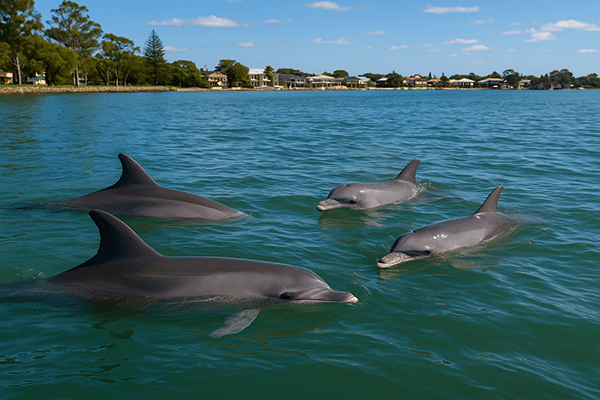
Discover the unique dolphin communities that call the Peel-Harvey Estuary home.
Mandurah isn’t just famous for its waterways — it’s home to one of the most fascinating dolphin populations in Western Australia. More than 85 Indo-Pacific bottlenose dolphins live permanently within the Peel-Harvey Estuary, forming a long-established community that has thrived here for generations. What makes this population remarkable is that individuals are born into it, rather than migrating in from coastal pods. These are true Mandurah locals.
Just outside the Dawesville Cut, another ~40 coastal dolphins roam the adjoining waters. They occasionally mix with the estuary residents, creating a dynamic and interconnected marine neighbourhood unlike anywhere else in the region.
Join us as we explore where these dolphins live, how they behave, and the challenges they face — and discover why Mandurah Estuary Dolphin Cruises offers one of the best opportunities to see them up close.
🌊 Where Mandurah’s Dolphins Live
The Peel-Harvey Estuary is a vast, interconnected water system, and Mandurah’s dolphins make use of every part of it. Sightings occur throughout:
- Peel Inlet
- Harvey Estuary
- Mandurah town waters & canals
- Murray, Serpentine & Harvey Rivers
While each dolphin has its own preferred “hangout spots,” the community spreads right across the system — which is why no two dolphin cruises are ever the same.
These waterways offer exactly what dolphins need to thrive: warm shallows, calm conditions, and a healthy supply of fish that make daily feeding easier. The lack of major predators seals the deal, turning the Peel-Harvey into a safe, family-friendly nursery for calves.
🐬 Dolphin Size, Speed & Lifespan
Mandurah’s Indo-Pacific bottlenose dolphins are impressive athletes and long-lived marine mammals:
- Lifespan: Often more than 40 years
- Length: Approximately 2.3–2.5 metres
- Weight: Up to 220kg
- Top Speed: Around 40 km/h (over four times Usain Bolt’s record pace!)
Their agility, breath-holding ability, and social intelligence make them one of the most captivating wildlife species to encounter on the water.
🔍 How We Identify Mandurah’s Dolphins
Every dolphin in the estuary has a name — and a unique dorsal fin that acts like a fingerprint. Notches, nicks, scars, and fin shape help researchers and volunteers recognise individuals year after year.
Some dolphins also carry distinctive body markings such as light patches or healed sunburn scarring from past strandings.
To help the community learn who’s who, local researchers have developed The Fin Book, an identification guide now in its sixth edition. It’s available for download and in print at local events.
More dolphin profiles — including individuals not yet featured in the Fin Book — will soon be added to the website.
🍽️ What Mandurah’s Dolphins Eat
The Peel-Harvey Estuary is a buffet for hungry dolphins. Their diet is mostly made up of fish, with daily intake changing by season:
- Summer: 6–8 kg per day
- Winter: 10–14 kg per day (extra blubber needed for warmth)
Dolphins often work together to round up fish, using sandbanks, rock walls, and tight teamwork to trap prey before striking. Over generations, Mandurah’s dolphins have developed clever, habitat-specific feeding strategies — including the shallow water tail-whack, a technique rarely seen elsewhere.
They also enjoy more challenging meals like octopus and cobbler, which must be tossed repeatedly to remove tentacles and venomous spines before eating.
🤝 Social Lives & Group Behaviour
Dolphins are deeply social animals, and Mandurah’s pods are constantly changing. Their community structure is known as a fission-fusion society, meaning:
- Groups form and disperse daily
- Individuals come and go freely
- There’s no “alpha” female running the pod
Females tend to travel with other females and their calves, forming strong networks, while males usually bond in pairs, creating powerful long-term alliances.
Play is a large part of dolphin life — from tail slaps and leaps to chasing, gentle nudging, and even tossing seaweed or octopus around like toys. These behaviours peak from December to May, when warmer waters and mating season increase social activity.
👶 Mandurah’s Newborn Dolphins
Most calves in the estuary are born in the warmer months (December–May). Pregnancy lasts around a year, and mothers generally give birth every three years.
Newborn calves:
- Weigh roughly 20kg
- Measure about 1 metre long
- Display pale folds along their sides (from foetal folding)
- Have tiny whiskers on their rostrum, which fall out shortly after birth
Calves stay by their mother’s side for up to three years, nursing for around 18 months before mastering the art of catching fish themselves.
For updates on Mandurah’s newest arrivals, follow the Mums and Calves page or the Mandurah Cruises Facebook community.
😴 How Dolphins Sleep (Without Drowning)
Unlike humans, dolphins must consciously surface to breathe — so they can’t simply drift off to sleep. Instead, they rest by shutting down one half of the brain at a time, allowing them to stay alert to breathe and monitor their surroundings.
During these restful periods, dolphins float near the surface with their blowhole exposed, taking a series of “micro-naps” that add up to around eight hours of rest per day.
You can even watch footage of Mandurah’s dolphins sleeping on the local YouTube channel — a rare and calming insight into their behaviour.
⚠️ Threats Facing Dolphins in the Peel-Harvey
As beautiful as the estuary is, it isn’t without risks. Mandurah’s dolphins face several challenges:
- Stranding in shallow waters
- Fishing line entanglement
- Ingestion of litter
- Shark bites
- Morbillivirus
- Boat strikes
Ongoing community education, monitoring projects, and responsible boating practices play a crucial role in protecting these beloved marine residents.
💙 Protecting Mandurah’s Dolphins
Local conservation groups and Mandurah Estuary Dolphin Cruises work continuously on educational programs, rescue efforts, and awareness campaigns designed to safeguard the estuary’s wildlife.
Visitors can help by:
- Disposing of rubbish responsibly
- Avoiding feeding or approaching dolphins in the wild
- Reducing fishing line waste
- Keeping safe distance while boating
- Supporting eco-friendly tourism practices
🛥️ Experience Mandurah’s Dolphins Up Close
Mandurah Estuary Dolphin Cruises offers year-round tours through the estuary’s calm, scenic waters — giving guests a chance to observe these incredible animals where they live, feed, socialise, and raise their young.
Every cruise is different, and every encounter offers something new. With each trip, you’re not just watching wildlife — you’re helping protect it.